The Numbers Look Good, But You’re Still Tired: The Gap Between Treatment and Energy
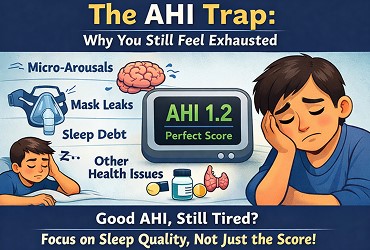
It’s one of the most frustrating moments in treating sleep apnea. You’ve done the work: you’ve been diagnosed with Obstructive Sleep Apnea (OSA), you’ve stayed consistent with your CPAP machine or your oral sleep appliance, and your latest data shows a "perfect" score. Your Apnea-Hypopnea Index (AHI) is low, meaning you’ve stopped stopped breathing significantly fewer times per hour.
Your doctor is happy. The machine is happy. But you? You’re still waking up feeling like you never went to sleep.
If your AHI numbers have improved but your energy levels haven't, you aren't alone. This is a common hurdle, and it happens for several very specific reasons.
Understanding the AHI "Trap"
The AHI is a great tool, but it is a narrow one. It measures how many times your airway completely or partially closes for at least 10 seconds.
However, a low AHI doesn't automatically mean "high-quality sleep." You can have an AHI of 2 (which is medically excellent) and still have highly fragmented sleep. Here is why:
1. Micro-Arousals and "Sleep Fragmentation"
Even if your CPAP or oral appliance prevents a full apnea event, your body might still be struggling to breathe. These "respiratory efforts" can cause micro-arousals—tiny brain-waves that kick you out of deep, restorative sleep and back into light sleep. You won't remember waking up, but your brain never gets the chance to truly "recharge."
2. The Difference in Devices
- CPAP Users: You might have a great AHI, but if your mask leaks slightly, or if the air pressure makes it difficult to exhale comfortably, your sleep is being interrupted by the treatment itself.
- Oral Appliance Users: While these devices are great for comfort, they sometimes reduce the severity of events without fully eliminating the "work" of breathing. If the jaw isn't positioned perfectly, you may still experience "flow limitation"—breathing that is technically "open" but still restricted and exhausting.
3. The "Sleep Debt" Lag
If you’ve lived with untreated sleep apnea for years, your body has accumulated a massive "sleep debt." It has been under constant cardiovascular and neurological stress. A few weeks of good AHI numbers won't always undo years of exhaustion. It often takes consistent use (6–8 hours every night) for several months before the brain's chemistry truly resets.
4. Co-existing Health Factors
Sometimes, OSA isn't the only thing stealing your energy. If your apnea is treated but you’re still sluggish, it’s worth checking for other common "energy vampires" like:
- Low Vitamin D or Iron levels.
- Thyroid imbalances.
- Restless Leg Syndrome (RLS).
- Insomnia or high stress levels.
What Can You Do?
If the numbers say you're "cured" but your body says otherwise, don't give up on your treatment. Instead, try these steps:
- Check Your "Leak" Data: If you use a CPAP, look at your mask leak data. A "low AHI" with a "high leak" usually means the therapy isn't actually reaching your lungs effectively.
- Refine the Fit: If you use an oral appliance, talk to your dentist. A tiny titration (adjustment) of the device might be the difference between "preventing apneas" and "breathing effortlessly."
- Look Beyond the 4-Hour Mark: Many people use their devices for the "required" 4 hours and then take them off. However, the most restorative REM sleep often happens in the second half of the night.
- Talk to Your Specialist: Tell them, "My AHI is low, but my fatigue is high." This may prompt them to look at your RDI (Respiratory Disturbance Index), which tracks those subtle micro-arousals that AHI ignores.
The Bottom Line: Treating sleep apnea is about more than just "fixing a number" on a screen; it's about reclaiming your life. If the numbers are good but you still feel bad, it's time to dig a little deeper into the quality of your rest.
Dr. Ekta Shah