The Sticky Truth: Is Chewing Gum Actually Good for Your Teeth?
As a dentist, I’m often asked if chewing gum is a "guilty pleasure" that ruins enamel. The answer might surprise you: I actually encourage many of my patients to chew gum—provided they are choosing the right kind.
Chewing gum isn't just about fresh breath; it’s a functional tool for oral hygiene when you're on the go. Here is the clinical breakdown of how it impacts your mouth.
1. The "Saliva Surge": Your Mouth’s Natural Cleanser
The physical act of chewing sends a signal to your salivary glands to get to work. Saliva is your mouth’s most powerful defense mechanism. By increasing saliva flow, chewing gum helps:
- Neutralize Acids: It buffers the acids produced by bacteria and those found in food (like soda or coffee).
- Remineralize Enamel: Saliva carries calcium and phosphate, which help strengthen tooth enamel.
- Wash Away Debris: It physically helps clear away food particles after a meal.
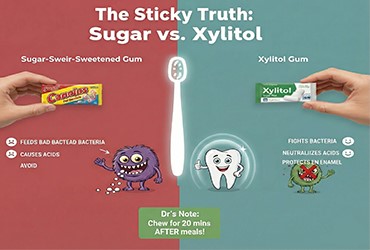
2. Sugar vs. Xylitol chewing gums:
The impact of gum depends entirely on what’s used to sweeten it.
- The "Bad": Sugar-Sweetened Gum. If you chew gum with real sugar, you are essentially "bathing" your teeth in a sugar bath. This feeds the bacteria that cause cavities. Avoid these entirely.
- The "Good": Sugar-Free (Xylitol). Most sugar-free gums use Xylitol, a natural sweetener that bacteria cannot digest. In fact, Xylitol actually inhibits the growth of Streptococcus mutans (the main bacteria responsible for cavities).
3. When to Be Cautious
While gum is great for teeth, it isn't for everyone. I advise caution for:
- TMJ Issues: If you have jaw pain or clicking (TMJ disorder), constant chewing can overwork the muscles and worsen the condition.
- Orthodontics: While some gums claim to be "brace-friendly," they can still get tangled in wires or pull on brackets.
My "Dentist-Approved" Recommendations
| If you want... |
Look for this on the label |
| Cavity Prevention |
The ADA Seal of Acceptance. This ensures the gum has been clinically tested to be safe and effective. |
| Maximum Protection |
Xylitol as the first sweetener listed. |
| Dry Mouth Relief |
Gums specifically formulated with phosphopeptides, which help rebuild enamel. |
In my opinion:
Chewing sugar-free gum for 20 minutes after a meal is an excellent supplement to brushing and flossing. It’s not a replacement for your toothbrush, but it’s the best "Plan B" when you are out for lunch or traveling.
Dr.’s Note: Always remember: if the gum has sugar, you're feeding the "cavity monsters." If it's sugar-free, you're fighting them.
"I always tell my patients: your smile is a window to your overall health." Understanding the relationship between oral care products and your long-term dental health is the first step toward a lifetime of healthy teeth and gums.
Until next time,
Dr. Ekta Shah, DDS
Member of the American Dental Association & California Dental Association